Paraguay

On 19 August, the Latin American and Caribbean Antimilitarist Network (RAMALC) launched a new issue of its magazine, Breaking Ranks. Bringing together statements, articles and opinion pieces, this issue offers a current perspective on the situation in the region, looking at militarism and the far-right structures that sustain it

The Latin American and Caribbean Antimilitarist Network (RAMALC) has shared this call for International Conscientious Objection Day. It's an invitation to stand against militarisation and war, refusing to be part of systems built on violence and exploitation. Don't count on us advocates for conscientious objection, antimilitarism, and solidarity all around the world.

Paraguay

Placheolder image
13/05/1998 1 Conscription

conscription exists

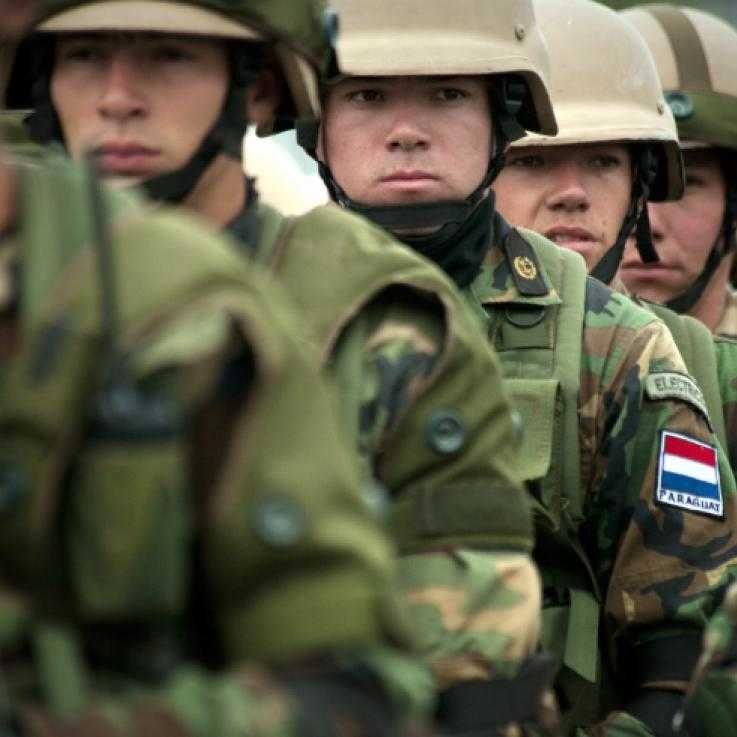
Law 569/75 regulates military service, which is compulsory according to art. 129 of the 20 June 1992 Paraguayan constitution. [2] [6]

military service

All men aged 18 to 50 are liable for military service. They must take an oath of obedience to the armed forces and the national police. [6]

Military service lasts for one year, and two years in the navy. [6]

High school students are allowed to perform their service in two five week stages.

After the military coup that ended the dictatorship of Alfredo Stroessner in February 1989, Paraguay went through a period of social and institutional demilitarisation. This process began early in the last decade of the last century and accelerated towards the end of that decade and the start of the next, its pace set by the national political context.

Return to Conscientious Objection: A Practical Companion for Movements

Rafael Uzcategui is a Venezuelan conscientious objector, author, and human rights activist who has been active with War Resisters' International, and in antimilitarism more generally, for many years. Here, he summarises the main tendencies of the Latin American conscientious objection movement, and details how his own nonviolent anarchist position fits into this picture.

During the eighties, many Latin American countries were living under military dictatorships or suffering the consequences of civil war. These were also the days of the Cold War, during which the US considered Latin America one of its 'zones of influence': almost like a back garden. The traumatic and progressive democratisation process meant that broad swathes of the continent's youth developed an antimilitarist sentiment, which began to take on an organised and political dimension. As an adolescent at the beginning of the nineties in Barquisimeto, a town 5 hours away from the Venezuelan capital of Caracas, my peers and I had to hide ourselves twice a year for fifteen days, to avoid compulsory military service. Otherwise they would seize us on the streets and, without wasting words, force us into a truck, with others just as terrified, and from there take us to the barracks. For many of us, these forced recruitment raids or 'press gangs' were the starting point for our rejection of authority and of the military uniform.

Last November in Paraguay, WRI's affiliate - Serpaj Paraguay - worked with with human rights organsation Codehupy to host an international mission, formed by 43 members from eight countries. The mission was organised to verify the sharp deterioration of human rights conditions in Paraguay, particularly since last August, when President Horacio Cartes took office. Last August, the Paraguayan congress passed a series of laws giving war-like powers to the executive.

Pelao Carvallo

Monsanto brought GM into Paraguay in the same way that it has usually done elsewhere: by smuggling. And smuggling imposed GM soya, Monsanto soon achieved its legalisation by means of a powerful lobbying apparatus. And along with this soya came aerial and ground fumigation of glyphosate, and with that poisonous pesticide came diseases, contamination, malformation and deaths. The parliamentary coup d’etat occurred not long after (15-22 June 2012), effected to a large degree by Monsanto's agents at the Paraguayan parliament.

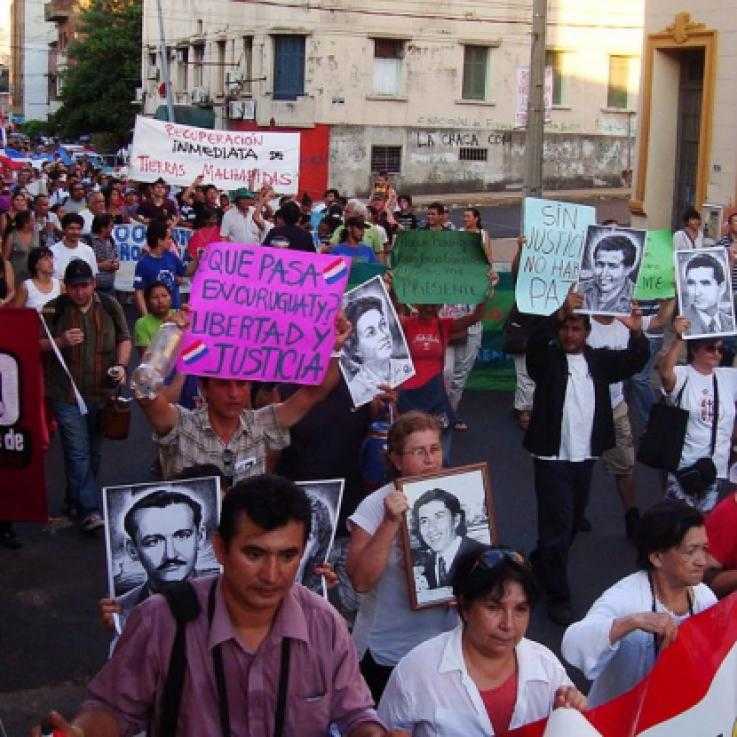
Paraguay's de-facto government of Federico Franco, which came into power after a "parliamentary coup" which ousted the country's elected President Fernando Lugo in June 2012, is increasing the pressure on conscientious objectors in the country. The department on conscientious objection reported that more than 500 young people apply for conscientious objection daily, to avoid a fine which is prescribed in the law on military service.

Editorial

Placheolder image

Since the coup d'etat in Paraguay, WRI has been following the situation in Paraguay closely. At the WRI Council meeting we had a session on Paraguay, where Council member, Pelao Carvallo, who lives in Paraguay, gave a presentation about how the coup was orchestrated and the resistance to it. As we send this statement, an antimilitarist week is taking place in Paraguay, with MOC Paraguay (a WRI affiliate) being one of the main organisers. WRI will continue to work in support of the Paraguayan antimilitarist and nonviolent movement.

Javier Gárate

Subscribe to Paraguay

In a world so divided, solidarity is everything. 

This summer we have a £5k fundraising goal. Click here to find out how you can help.